
Trip Builder
An AI travel companion to accompany your trip and help plan along the way.
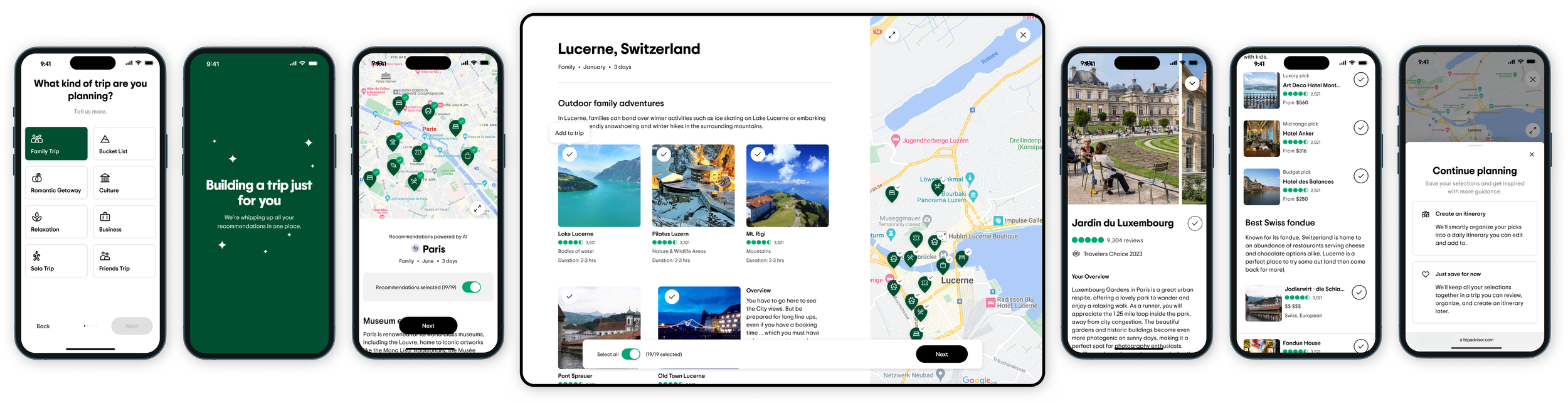
Background
My role
Product designer, responsible for discovery, research, and redesign of the AI tool.
Timeline
5 Months (April 2025 -August 2025)
Team
Product designer, 2 product managers, 1 director of product design, 10 back-end engineers, 8 data sciene & machine learning, 4 front-end engineers
Trip Builder started as an AI itinerary generator, but we soon learned that people didn’t want automation — they wanted inspiration. Trip planning can be one of the most exciting — and overwhelming — parts of travel. To make this process more intuitive and inspiring, Tripadvisor launched the GAI Itinerary Builder, an AI-powered planning tool designed to help travelers create personalized itineraries in minutes. The first version (V1) allowed users to input destinations and preferences, generating a complete, day-by-day trip itinerary using AI. While the feature saw strong initial engagement, continuous research revealed that travelers were using the tool in more exploratory, inspiration-driven ways rather than committing to fully structured plans.
Over the 6 months, our team conducted extensive user research and behavioral analysis to understand how travelers interacted with GAI Itinerary Builder. We observed that many users wanted to refine and customize their trips before saving them, and that the AI’s recommendations often felt too broad or “one-size-fits-all.” With these insights in hand, we set out to design and re-launch the GAI Trip Builder — a reimagined experience with a more flexible interface, a smarter recommendation engine powered by Tripadvisor’s semantic search model, and a greater sense of personalization and control for every type of traveler.
Problem
We noticed travelers were dropping off after generating an itinerary. In interviews, they told us the AI felt like it was “planning for them,” not with them. Engagement data backed this up — only 21% of trips were being saved. The challenge was clear: make AI feel like a collaborator, not a replacement.
How might we create a delightful planning tool that transforms generic recommendations into meaningful, customizable itineraries that feel uniquely their own?

V1: The Itinerary Builder Landscape
Tripadvisor launched the first version of the Itinerary Builder in early 2023, right as generative AI was reshaping how people interacted with technology. The tool let travelers instantly create day-by-day itineraries from prompts like “plan me a weekend in Rome,” using Tripadvisor’s vast dataset of reviews and listings. V1 was a proof of concept — an early step in exploring how AI could make trip planning faster, smarter, and more personal.
-
Lack of Personalization: Recommendations felt too generic, with limited understanding of traveler intent, preferences, or context (e.g., family trip vs. romantic getaway).
Low Trust in AI Output: Many users didn’t feel confident in the quality or relevance of the AI-generated itineraries. They often cross-checked recommendations manually, reducing the perceived value.
Static Experience: The interface didn’t allow users to refine, edit, or filter recommendations before saving, making it feel like a one-way output rather than a collaborative planning tool.
Limited Engagement Beyond Generation: Users generated trips but rarely returned to edit or act on them, leading to low conversion to saves or bookings.
No Real-Time or Contextual Awareness: V1 couldn’t adapt to users’ current location, timing, or travel logistics, limiting its usefulness while on the go.
Missed Opportunities for Community Insight: Users wanted reassurance through recent reviews, photos, and validation from other travelers, but the AI experience surfaced limited context beyond listings.
-
Proof of Concept Success: V1 validated that users were open to planning trips through an AI-powered assistant. It demonstrated clear interest in generative trip planning and set the foundation for Tripadvisor’s AI roadmap.
Novelty & Engagement: The idea of generating a full itinerary in seconds was exciting to users, driving strong initial engagement and curiosity.
Core Integration: V1 successfully connected with Tripadvisor’s existing data ecosystem, pulling in hotels, attractions, and restaurants to populate itineraries using trusted review content.
Ease of Entry: Users appreciated the simplicity of entering a prompt (“Plan me a 3-day trip to Paris”) and receiving an instant plan—it made travel planning feel accessible and efficient.
Key user needs

Through user research interviews, we identified the most important needs for travelers: access to personalized guidance from anywhere (especially on the go), tailored recommendations for hotels, attractions, and restaurants, the ability to easily save and book suggestions, confidence in community-backed and inclusive decisions, tools to maximize time in-destination, and even support for non-travel-related questions.
Business KPIs

Recognizing that users who create trips are significantly more valuable than non–trip creators, the redesign focused on increasing engagement and conversion within the trip creation flow.
By redesigning the user experience and integrating a new semantic search model powered by Tripadvisor’s extensive review data, V2 makes trip planning more dynamic, relevant, and user-driven. It transforms the AI assistant from a static planner into a collaborative travel companion that adapts to each traveler’s preferences.
Key outcomes included:
Higher rate of recommendation generation within the US point of sale
Increased rate of saving recommendations from the GAI output
Greater engagement with AI-generated trips after creation
Improved user satisfaction with AI-generated recommendations, measured through thumbs up and down feedback on the results page

Final Designs
Final Designs

Personalized recommendation
The new semantic search model, powered by Tripadvisor’s vast review data, made recommendations feel more relevant to each traveler’s intent. Instead of simply matching keywords, the AI understood meaning — for example, recognizing that “romantic Paris spots” and “quiet restaurants for couples” share the same goal.
We added a few short onboarding questions to learn more about each traveler’s style, which allowed the model to recommend smarter and faster.
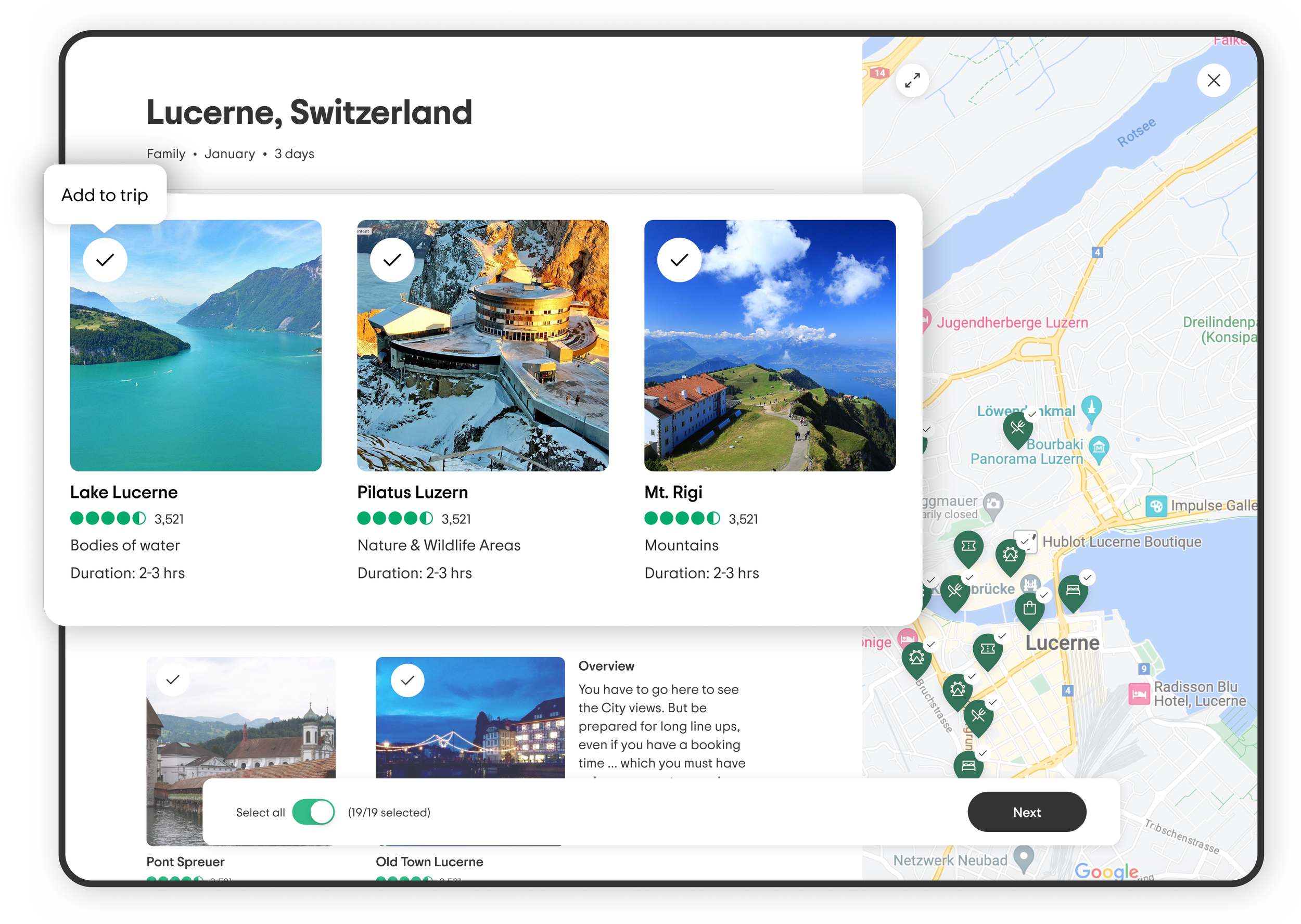
Easily save & book recommendations & guidance
In V1, saving recommendations to a trip was clunky and disconnected — users had to jump between pages, and saved items didn’t always carry context (like when or why they were added). V2 streamlined this by integrating saving directly into the AI flow, making it frictionless, contextual, and rewarding.
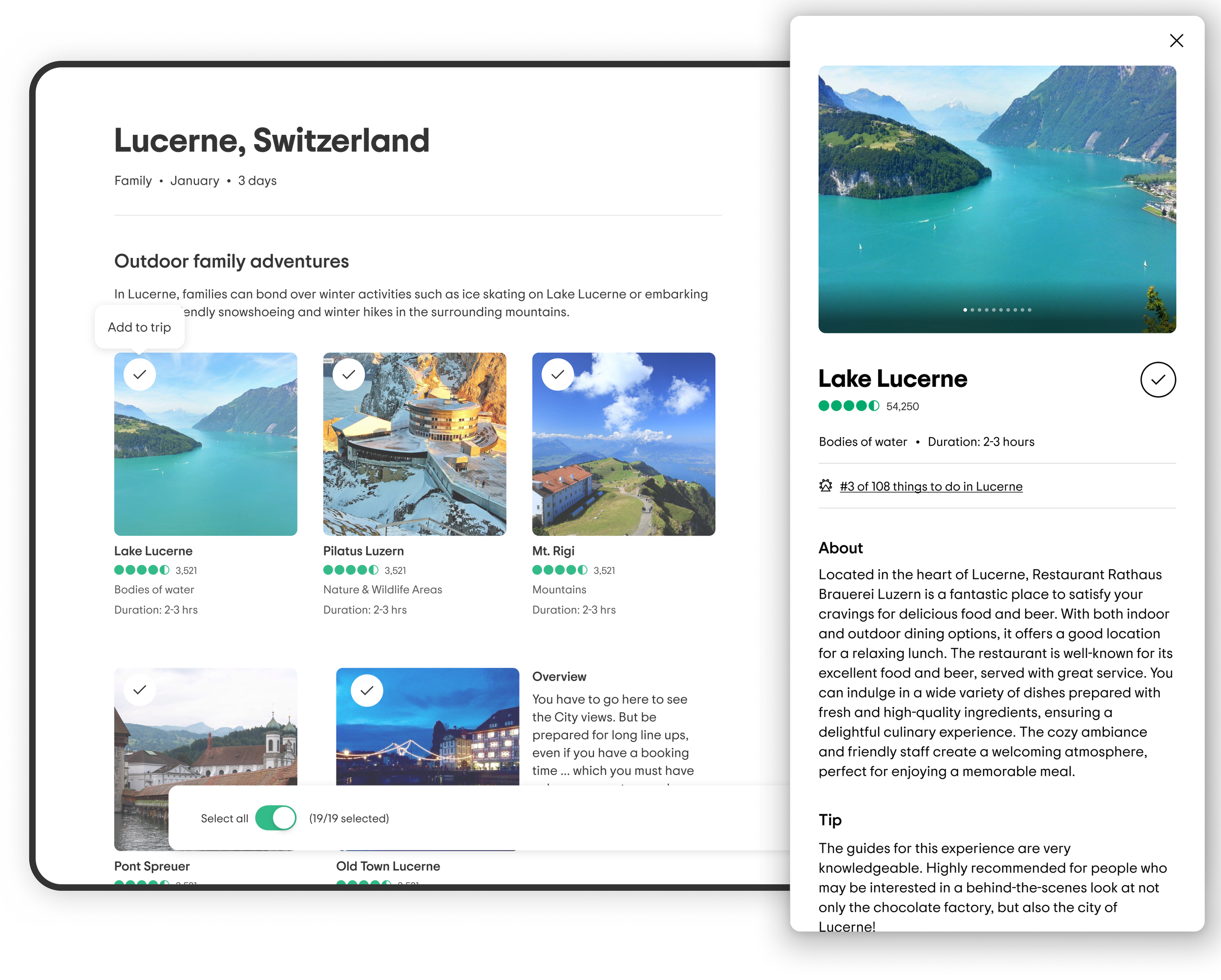
Community-backed travel decisions
We asked ourselves: Why plan with Tripadvisor? The answer is simple — our community.
We infused community insights directly into the Trip Builder experience. AI summaries now explain why a place is recommended, helping travelers understand local context. We also surfaced top-rated spots loved by real people, clearly marked with “community favorite” signifiers.
The result was a planner that felt more personal and trustworthy — shifting from a purely algorithmic tool to one grounded in the voices of millions of travelers.
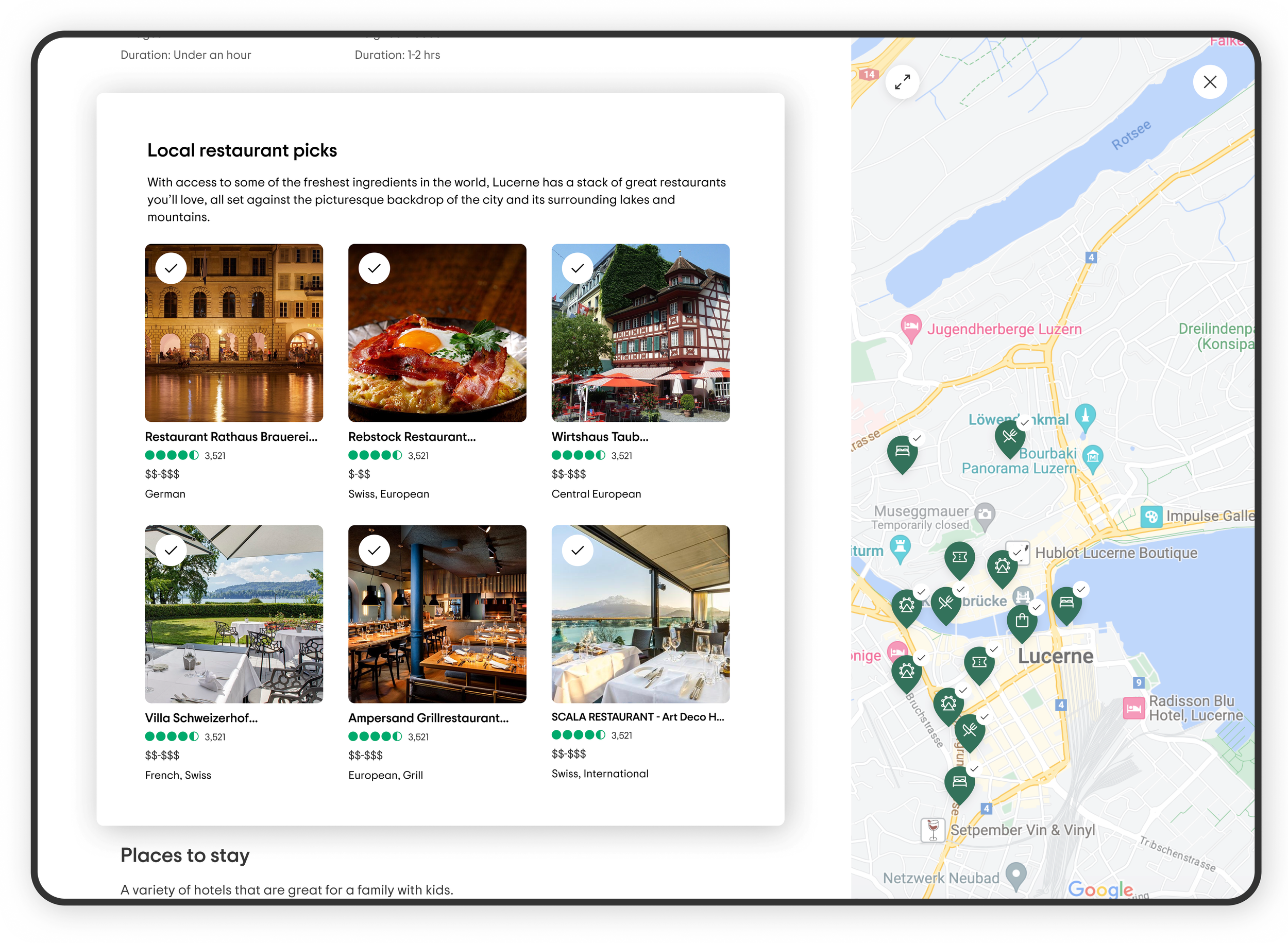
Destination exploration
V2 introduced structured groupings (Hotels, Restaurants, Attractions, Experiences, etc.), allowing travelers to browse and compare recommendations more intuitively. This reduced cognitive load and encouraged deeper exploration within each category.
Results
Increased trip creation by 180%
By redesigning TripAdvisor’s AI Trip Builder with improved UX flows, making saving simpler and creating a direct path to saving.
+45% increase in product engagement
By allowing users to iterate earlier in the proess, the dedicated trip became 2X more valuable than having a produced itinerary with no input from the user.
Next steps
Awards
Stevie Gold Business Award
2024
Q2 Voted Most Innovative Product
2025
Building an AI-driven experience taught me that people don’t want technology to plan for them — they want it to plan with them. The closer the product felt to the voices of real travelers, the more confidence users had in their plans.
Next, I’d like to explore how we can help travelers past the planning stage and while they are actually in their destination of choice. Itineraries always need iteration. How can Tripadvisor help, on the go?